

WeChat Mini Programs are often introduced as “apps inside WeChat”. That is true, but it is not the reason businesses should care. The real reason is leverage: a wechat mini program can turn attention into action with fewer steps than a website, and it can keep customers coming back without asking them to install anything.
If you are building in China (or selling to Chinese consumers abroad), Mini Programs are frequently the conversion layer of the funnel: content, creators, and ads create intent, and the mini program in WeChat is where users browse, book, pay, redeem, and repeat.

This guide explains what WeChat Mini Programs are, how they work, why they matter for marketing and e-commerce, and how to approach WeChat mini program development in a way that produces measurable business results.
What Is a WeChat Mini Program
A WeChat Mini Program (often shortened to “Mini Program”) is a lightweight application that runs inside WeChat. Users do not download it from an app store. They open it through WeChat and can return to it later through their recent list, favorites, chat shares, QR codes, or Official Account menus.
If you are asking “what is a wechat mini program” in practical terms, it is a product experience inside WeChat built to help users complete a task immediately: buy something, book a service, join a membership program, request support, or access a tool.
Mini programs are something in between a web landing page and a native app:
- faster and more “product-like” than most mobile web pages
- lower friction than a standalone app
- deeply integrated with WeChat distribution, identity, and social sharing
Where to Find WeChat Mini Programs
Users typically enter a mini program in WeChat from context. The most common entry points are:
-
QR codes
Printed materials, packaging, in-store signage, events, posters, and even digital flyers.
-
WeChat Official Account menus
A stable “home base” for brands that publish content and want a persistent button to conversion.
-
Shares in chats and group conversations
One tap and the user is inside. If you design the experience to be share-worthy, this becomes an organic growth channel.
-
WeChat search
Works well for brand queries and some intent-based searches inside the platform.
-
Ads that open directly into the Mini Program
This removes extra steps and reduces drop-off.
This also answers the common query “how to install WeChat mini program”: typically you do not install anything. You open it. WeChat keeps it accessible for the next visit. The closer you keep the user to the action, the better the conversion.


Mini Programs menu interface/ Mini Programs of Printer/ Uniqlo Mini Program
How a WeChat Mini Program Works
A Mini Program works through five stages: entry, value, trust, action, and return. The first screen decides everything. It must make the next step obvious and feel safe.
Most fail not from missing features, but because:
- The entry point leads to a generic page, not the promised scenario.
- The first screen lacks trust signals like clear pricing or visible support.
- The flow asks for data before proving value.
In the first few seconds, answer three questions: What can I do here? Why trust this? What do I click next?
Why WeChat Mini Programs Matter for Marketing and E-Commerce
China is mobile-first, and WeChat is not just messaging. It is where users communicate, discover brands, share recommendations, and increasingly complete transactions and service tasks. Mini Programs match this behavior by keeping users inside the same environment from discovery to payment.
Key Features and Benefits of WeChat Mini Programs for Businesses
A strong wechat mini program is not defined by a long feature list. It is defined by how reliably it converts and how consistently it brings users back. The most valuable capabilities usually include:
-
Fast, app-like user experience inside WeChat
Speed and familiarity reduce hesitation, especially for first-time buyers.
-
Commerce and booking flows
Depending on your business model, Mini Programs can support product catalogs, cart and checkout logic, appointment booking, deposits, and order confirmations.
-
Social sharing as a growth lever
Users can share the Mini Program to friends and groups. This is one of the strongest organic distribution mechanics available to brands in China.
-
Membership and loyalty mechanics
Points, tiers, coupons, referral rewards, and member-only offers can be built into the experience, increasing retention and repeat revenue.
-
After-sales and customer support
Order status, returns, FAQs, and support intake can be handled inside the Mini Program, reducing pressure on the team and improving satisfaction.
This also answers the common query “how to install WeChat mini program”: typically you do not install anything. You open it. WeChat keeps it accessible for the next visit. The closer you keep the user to the action, the better the conversion.
How to Use a WeChat Mini Program for Business: 5 proven scenarios
If you are unsure how to use wechat mini program formats, start with the scenario that matches your core business goal. The table below is a practical shortcut for planning.
| Main Goal | MVP features | Primary KPI |
|---|---|---|
| E-commerce | catalog, product pages, cart, payment, delivery/returns info, support | pay success, conversion rate, repeat purchase |
| Service booking | time slots, booking confirmation, deposit (if needed), reschedule/cancel, reminders | booking success, show-up rate |
| Lead generation | quiz/calculator, form, qualification logic, CRM integration | qualified lead rate, cost per lead |
| Membership/loyalty | points, tiers, coupons, history, personalized offers | member activation, coupon redemption, 30-day retention |
| After-sales | order status, instructions, warranty/returns, support requests | support deflection, CSAT, repeat rate |
This is the fastest way to keep Wechat mini program development focused: pick one scenario for version 1, build the shortest path to that outcome, then iterate.
CASES of Successful Brand Mini Program Patterns
Instead of abstract patterns, here is what the same logic can look like for two real brands. These are not «the only correct flows». They are practical, repeatable scenarios, which are united into a Mini Program.
CASE 1: Swisse (supplements) — «match me» funnel, but for health goals
A Swisse Mini Program can win when it does not start with the full product catalog. It starts with the user’s goal and turns that into a confident first purchase.
A typical flow can look like this. The user enters from a creator video, a KOC recommendation in a group chat, or a post in the Official Account that speaks to a конкретный запрос: sleep, stress, immunity, skin, hair, energy. The first screen confirms the promise immediately: a short «Find your routine in 60 seconds» assessment focused on goals, plus trust elements that reduce hesitation (clear usage guidance, what the bundle is for, what to expect, and obvious access to support).
The action is a quick quiz that ends with a simple recommendation: a 2–3 product starter set tailored to the user’s goal, with a clear explanation of why these items belong together and how to take them. Checkout is the shortest possible path: minimal friction, no forced account creation before the point of purchase, and no distracting navigation that pushes the user back into browsing.
Return is built through practical retention, not hype: reorder shortcuts based on the selected routine, reminders that match the supplement cycle, and member benefits that make repeat purchasing feel logical (not like constant promotions). The user feels guided, not sold to, which is exactly why this approach converts well for supplements.
Why it works: the user is not asked to «become a supplement expert». The product does the thinking, and the bundle reduces decision fatigue.
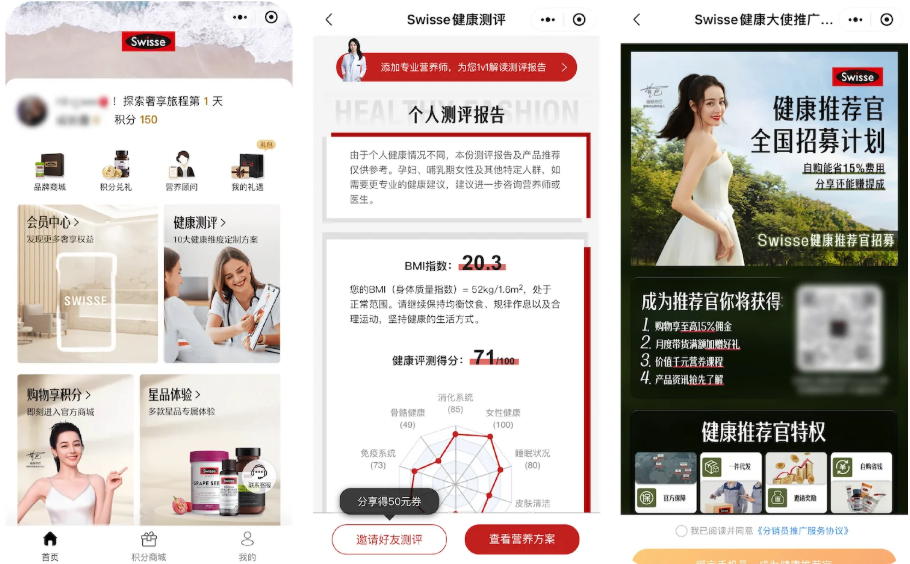
CASE 1: Swisse (supplements) WeChat Mini Program
CASE 2: MISTINE (beauty) — «match me» funnel, but for shade and routine confidence
For a mass beauty brand like MISTINE, the biggest friction is uncertainty: shade mismatch, «will it suit me», and «where do I start». A Mini Program can remove that uncertainty faster than a traditional e-commerce site.
Entry can come from short videos (creator looks, before/after, routines), from shareable «what shade are you» content in chats, or from QR codes on packaging and offline materials. The first screen should not be «home». It should be a scenario: pick your goal (daily makeup, long-wear, brightening, acne-friendly, etc.) or match your shade in under a minute. Trust here is less about «policies» and more about clarity: shade guidance, finish explanation, wear-time expectations, and visible social proof such as best-sellers or review snippets.
The action is a short matching experience: quick inputs that lead to a specific recommendation. The output should not be 20 items. It should be a tight kit: for example, a base product + one supporting product + one hero item (like a lip or eye product) that completes the look. Checkout stays focused, with an easy way to save the routine for later.
Return is built through «make it easy to repeat»: saved looks, reorder and restock prompts, member pricing for essentials, and occasional personalized drops that match the user’s saved preferences. If the Mini Program makes it effortless to recreate a look, it becomes a привычка, not a one-time store visit.
Why it works: beauty conversion is driven by confidence. The Mini Program’s job is to remove doubt fast and turn «I’m not sure» into «this will work for me».
If you want internal linking, this section is ideal for linking to your case studies and relevant services because the reader is already thinking in flows and looking for proof of execution.
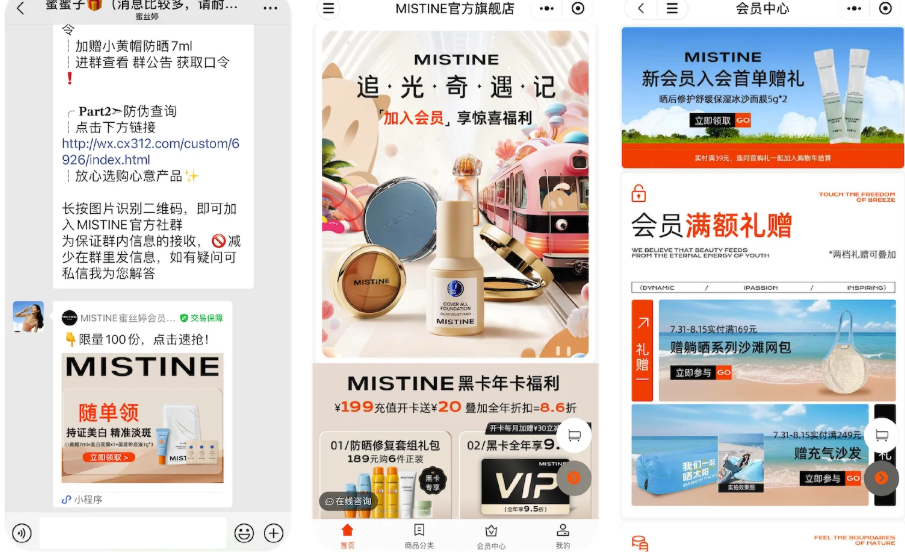
Tips for Marketers to Launch a WeChat Mini Program
These steps are the difference between “we built something” and “we built something that converts”.
-
Define Your WeChat Mini Program Goals and Audience
Choose one primary goal for version 1. Not “e-commerce + community + CRM + content”. One job. Then define how users will enter: QR, Official Account, KOL traffic, ads, or shares. Your entry source should influence your first screen and messaging.
-
Set Up a Verified WeChat Official Account
In many setups, a verified Official Account supports trust and navigation (menus, content routing). Treat verification and documentation as a timeline risk and start early.
-
Map the User Experience (before design and development)
Use this simple structure:
Entry → Hook (value promise) → Proof (trust) → Action (conversion) → Return (retention)
-
Choose Your WeChat Mini Program Development Approach
When teams ask “how to build wechat mini program fast”, the answer is usually scope discipline. You typically choose between:
- custom build for unique UX and integrations
- template/SaaS for speed with constraints
- hybrid for a stable base plus custom modules
- custom build for unique UX and integrations
-
Prepare for Tencent review
Review is not an afterthought. Build a pre-review checklist: correct category, compliant copy, transparent rules, stable flows, and no misleading screens.
-
Launch with a promotion plan
A Mini Program without distribution will not grow. Plan at least three launch channels:
- owned: Official Account, existing audience, CRM
- paid: ads that open directly into the Mini Program
- social: creators, sharing incentives, community posts
- owned: Official Account, existing audience, CRM
-
Monitor, update, and optimize
Track funnel events so you can fix what actually breaks. A minimal analytics setup should include: open, view item/service, add to cart/select slot, begin checkout/confirm booking, pay success/booking success, share click, and support click.
Common mistakes that kill performance and how to avoid them
-
Sending traffic to a generic home screen
Fix: deep-link users into the exact scenario promised by the ad or post.
-
Weak trust signals on the first screen
Fix: show clear policies, support access, transparent pricing, and proof (reviews, best-sellers, credentials).
-
Forcing registration too early
Fix: let users experience value first, then ask for details only when needed.
-
Mismatch between creative promise and product reality
Fix: align ad copy, first screen, and conversion flow to the same promise.
-
No reason to come back
Fix: retention hooks such as membership, coupons, reorder shortcuts, reminders, and post-purchase content.
-
No “plan B” for uncertain users
Fix: add a tight FAQ, fast support entry, and clear comparisons/ guarantees where relevant.
FAQ
Users can share a Mini Program directly in WeChat chats and group conversations, and sometimes via Moments. For growth, the key is to design a reason to share: referrals, group unlocks, useful tools, member-only coupons, or limited offers.
The total number changes constantly and depends on definitions (registered vs active). For business planning, it matters more how discoverable you are in your category and how strong your entry points are (QR, Official Account, creators, ads).
An app must be installed and maintained as a separate product. A wechat mini program runs inside WeChat, opens instantly, and benefits from WeChat-native distribution and sharing. Mini Programs usually win when you need low acquisition friction and fast iteration.
Yes, but setup often involves verification, documentation, and infrastructure decisions. Plan these early because they can affect timelines more than design.
They can, but effectiveness depends on whether your audience actively uses WeChat in that market. Where WeChat usage is low, treat the Mini Program as an additional conversion layer rather than the primary channel.
It depends on scope and integrations. A focused MVP for one scenario is cheaper and faster than a feature-heavy build. Budget for post-launch optimization, not only initial development.
Yes, typically with user authorization and within platform rules. Use notifications for utility (order updates, booking reminders, service messages). Overuse reduces opt-ins and hurts retention.
The most reliable mix is QR codes, Official Account content and menus, ads that open directly into the Mini Program, and KOL/KOC distribution. Sharing incentives inside chats and groups can become a scalable organic channel if the product is designed for it.