

By 2026, the myth that Xiaohongshu is simply “the Chinese Instagram” has been completely shattered. Both platforms deal with visual content, but their inner workings, user behavior, and commercial potential have diverged so much that trying to apply a single strategy will burn your budget. These are no longer competitors — they are two different worlds, and brands need to choose where they want to win.
Scale and audience: global reach vs. targeted precision
Instagram in 2026 has over 3 billion monthly active users. Average session duration is nearly 13 minutes. 80% of US adults aged 18–29 use Instagram, and one third of all users (33.3%) are between 25 and 34. Gender split is nearly even. Key markets: India (390+ million), the US (170 million), and Brazil (140 million). Important note: Instagram is blocked in mainland China.
Xiaohongshu (Little Red Book) tells a different story. According to platform data for 2026, monthly active users have reached 376 million worldwide, with daily post views hitting 9.12 billion. Users open the app an average of 16 times per day, and the platform processes over 1 billion search queries every month.
The real difference is not size but composition. Around 70% of Xiaohongshu users are women, and of those, 72% are under 30. 66% of users are married, and 83% have children — making the platform effective not just for beauty and fashion, but also for baby products, home goods, and sports equipment. Half of the audience lives in first- or second-tier cities (Beijing, Shanghai, Guangzhou, Shenzhen), and over 65% hold a college degree. These are high‑spending consumers. Outside China, Xiaohongshu is growing fast: in Hong Kong, penetration has reached 62%, and among Gen Z it’s an incredible 90%.
Algorithms: how users find content
Instagram in 2026 uses multiple algorithms (Feed, Reels, Stories, Explore). The common goal is to keep users inside the app. The key ranking signal is freshness. Meta’s algorithm update now prioritises Reels published on the same day, giving them 50% more reach. This means success requires a constant stream of new content that hooks viewers within the first seconds.
- Reels (the main reach driver): the algorithm looks at watch time and rewatch rate.
- Feed: saves and shares are weighted much higher than simple likes.
- Stories: they drive retention; if a user regularly watches your Stories, your Feed content gets a boost.
- Explore: helps you find new audiences based on visual similarity.
Organic reach on Instagram continues to decline down 12% from last year. In 2026, a Feed post typically reaches only 3–4% of your followers.
Xiaohongshu is built on a completely different paradigm. Search is not an add‑on, it is the foundation. The platform works as a search engine with a social layer, where content lives and dies by user intent, not virality.
Nearly 70% of active users use search before making a purchase, and over 85% of those queries are proactive, the user came with a clear goal. The 5th‑generation Xiaohongshu algorithm ranks content based on the CES (Community Engagement Score). In 2026, the formula looks like this:
1 like + 1 save + 4 comments + 4 reposts + 8 follows.
Comments, reposts, and follows are valued 4 to 8 times more than likes, and deep comments (longer than 15 characters) carry even more weight. Moreover, Xiaohongshu uses a multi‑level traffic pool system: a new post is shown to 100–500 users, and based on CTR and engagement, the system decides whether to push it to the next level. One well‑optimised post can bring organic traffic and sell your product for 3 to 6 months.es to decline down 12% from last year. In 2026, a Feed post typically reaches only 3–4% of your followers.
Content and influencers: what works and why
On Instagram, visuals and emotions still dominate. Reels account for 46% of time spent in the app and are shared over 4.5 billion times per day. Influencer marketing here is hierarchical (nano, micro, macro, mega) and easily recognised as sponsored by the audience.
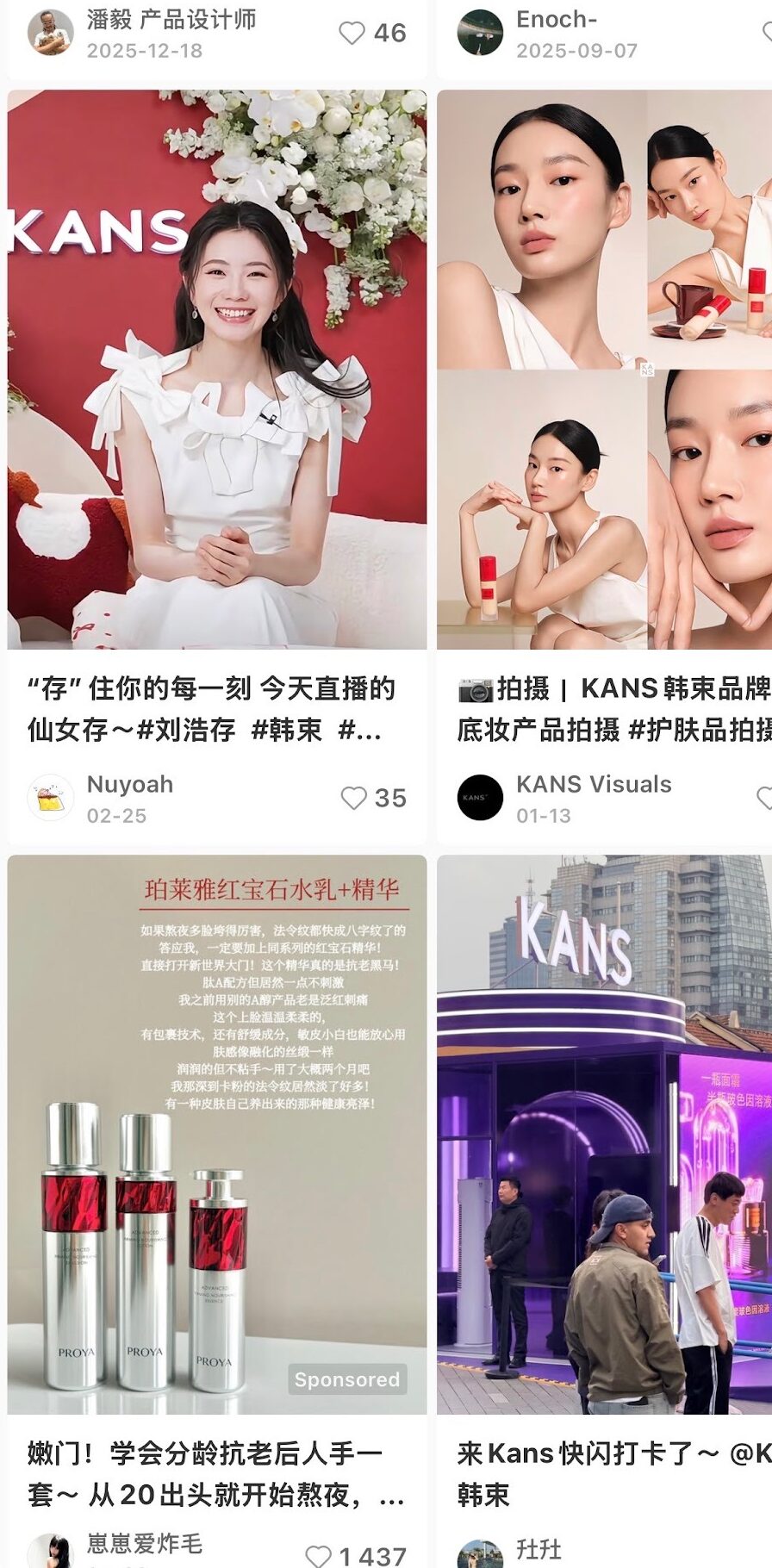
On Xiaohongshu, more than 80% of post views come from users who do not follow the creator. Follower count hardly matters — what matters is relevance to the search query. That is why KOCs (Key Opinion Consumers), everyday people with 1,000 to 50,000 followers, can easily outperform KOLs with half a million followers.
KOCs are perceived as “a friend’s advice”. Trust in them is rock‑solid: 52.9% of users in Hong Kong rely on user‑generated content (UGC), while only 22.4% trust official brand content. Engagement rates for KOCs reach 7%, compared to just 1–2% for mega‑influencers.

The best strategy in 2026 is hybrid: use Reels for fast global discovery, and Xiaohongshu for deep research and closing sales with Chinese audiences. Critical rule: content must be unique per platform. Direct cross‑posting kills trust and effectiveness.
In 2026, Instagram and Xiaohongshu are not competitors, they are two stages of the same consumer journey. Instagram answers the question “What new and beautiful thing can I buy?” (awareness). Xiaohongshu answers “Why should I buy exactly this, and from whom?” (research and conversion). Global brands that try to cross‑post the same content fail. Those that create separate strategies for each platform, invest in authentic UGC on Xiaohongshu, and use Instagram for mass reach, they win.
If your goal is the Chinese market, Little Red Book is not an option, it’s a necessity. If your goal is the rest of the world, Instagram remains the flagship. The best results come from a combination built on understanding the differences.
FAQ
Absolutely not. That’s a guaranteed failure. Xiaohongshu needs long, useful texts (500+ characters), real “before/after” photos, and SEO‑optimised headlines. Instagram needs short, emotional videos. Content that works on one platform will feel alien on the other.
Xiaohongshu. Organic reach for an Instagram Feed post has fallen to 3–4% of your followers and heavily depends on Reels recommendations. On Xiaohongshu, a quality post can keep bringing views through search for 3–6 months without extra ad spend.
Not necessarily. You can run an account through a foreign entity, work with KOLs/KOCs, and publish content. However, full access to the ad account and native shop requires local registration (or partnering with a local operator).
Never delete them — that will trigger platform penalties. The only correct strategy is to respond publicly, transparently, and constructively, showing that the brand cares and is improving.
The main metric is saves (collections) . They show that your post is seen as a useful guide that users will return to. Also important: long comments and the search queries that lead users to your content.
Xiaohongshu. Organic reach still works. On Instagram, it’s almost impossible to grow without paid promotion today.
No. It’s growing rapidly in Hong Kong (62% penetration), Malaysia, Singapore, Thailand, and among the Chinese diaspora in the US, Canada, Australia, and Europe.
Yes, if you have the resources. But with different content strategies and different creative teams (or at least different approaches). No cross‑posting.